Effect of Round
Analysis
Is there a relationship between Eredivisie rounds and draws?
TLDR
- Rounds are a poor predictor for how many draws there will be
The round that a match is played could be a predictor to a draw. For example, at the end of the season when 2 teams play each other without anything being on the line, they are possibly less inclined to take any risks to win their match.
But this is conjecture, so let’s dig into the data to see if there is any relationship between when a match is played and draws.
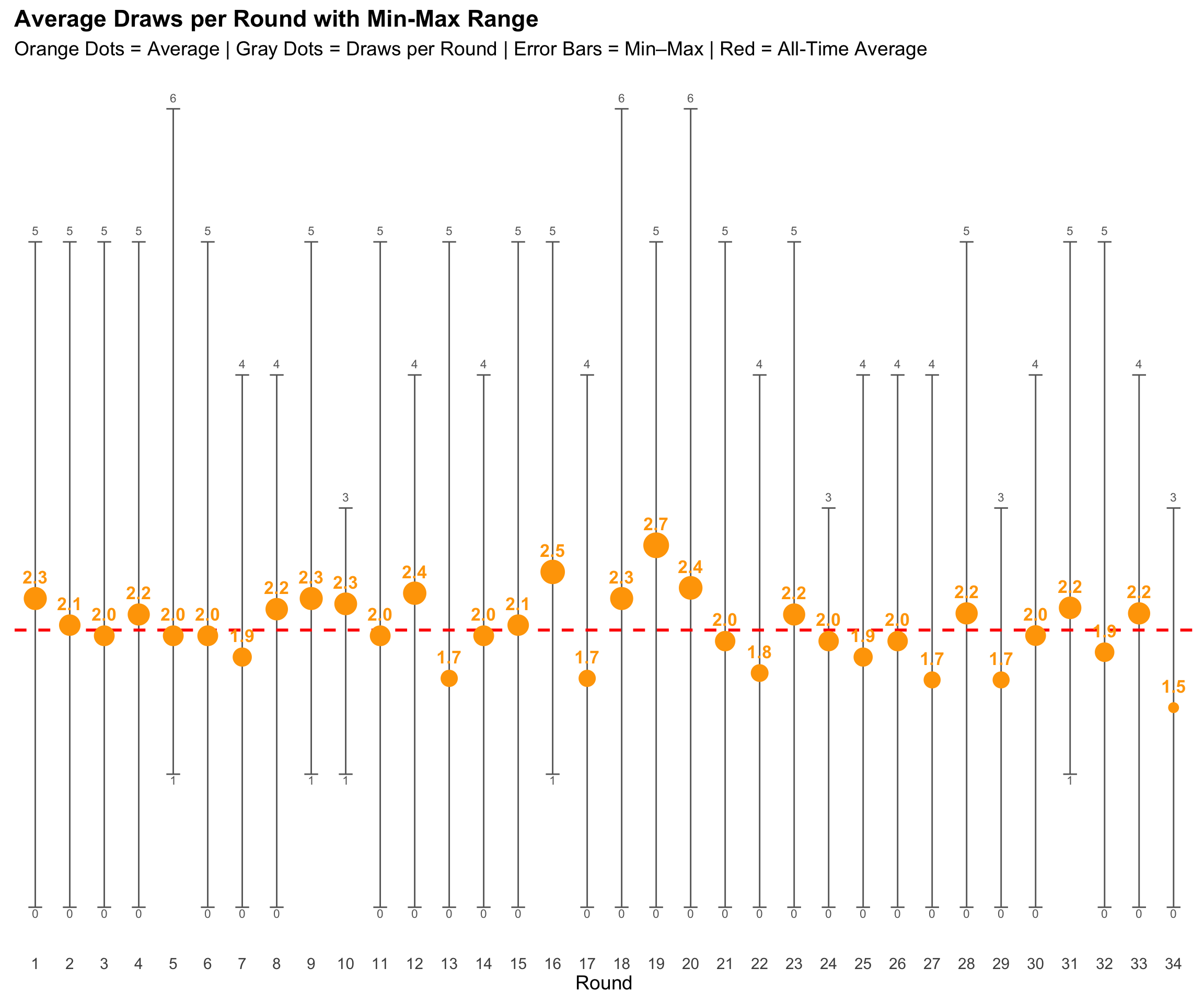
Above I’ve plotted the average draws per round for the past 25 years of Eredivisie. I wrapped each round in a max and min bar. Some observations:
small bandwidth around the all-time average of 2.1
max average is round 19 with 2.7
min average is round 34 with 1.5
all-time max draws of 6 occurred for only 3 rounds
except for 5 rounds, the minimum of 0 draws occurred in every round
Can we therefore always expect about 2 draws per round?
Probably not, so I want to run some regressions to be more precise. Regressions will let me estimate intercept (instead of that average), effects per rounds, and significance (chances of coincidence per effect). Let’s start with the effect of round (as categorical variable) on whether a match will be a draw or a non-draw (as dummy variable).
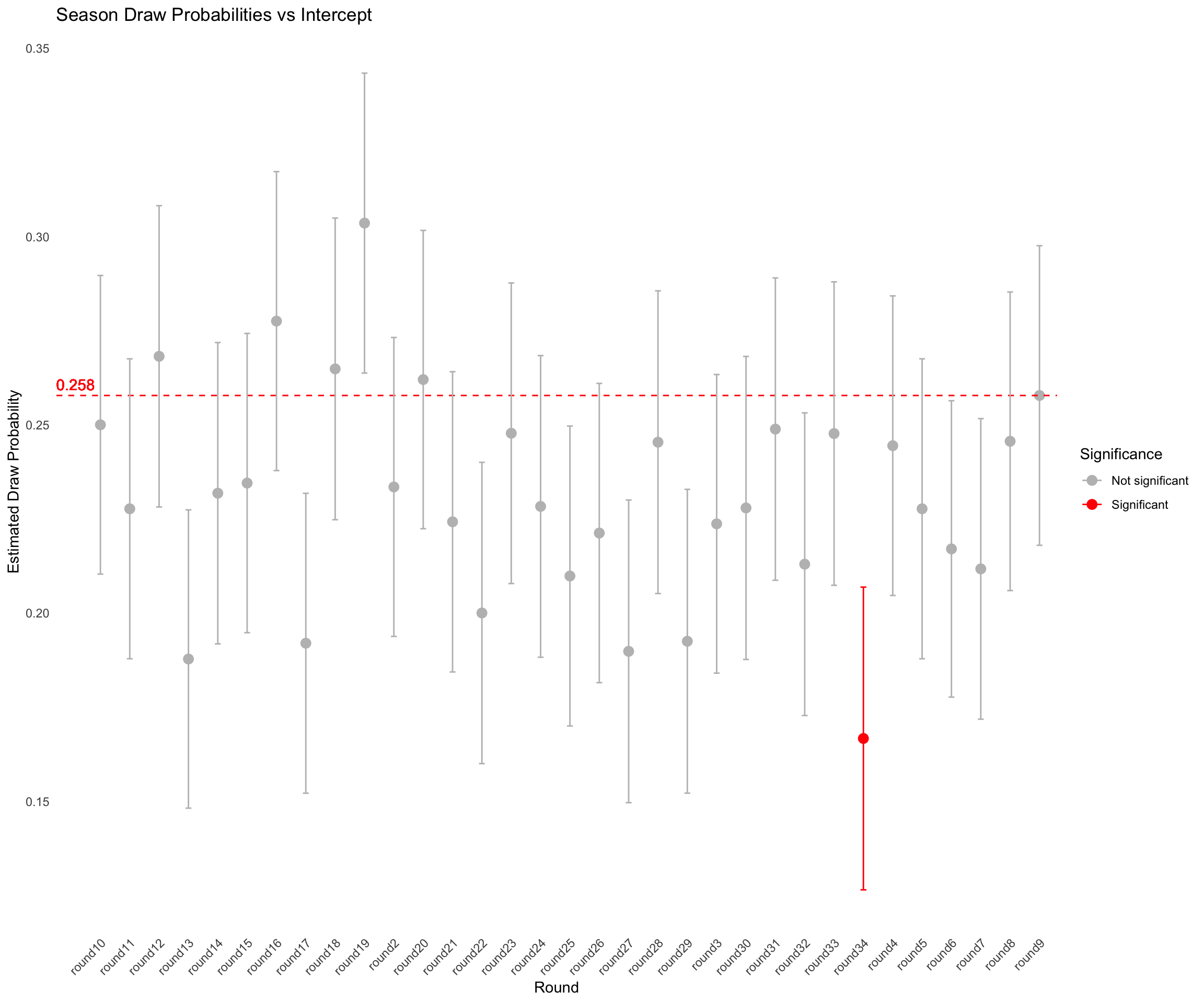
Regressing round on draw or no draw shows:
a significant intercept of 0.258 — 25% chance of any match drawing
One significant effect: round 34 causes -0.09 on the intercept — so 24% chance for round 34
No other round with any significant effect
An adjusted R-squared of 0.0001508 with a p-value of 0.4129 — a poor model to predict
In other words, this is a lousy way to predict. So let’s try another angle by zooming out a bit to seasons. So let’s run a regression to estimate difference between seasons.
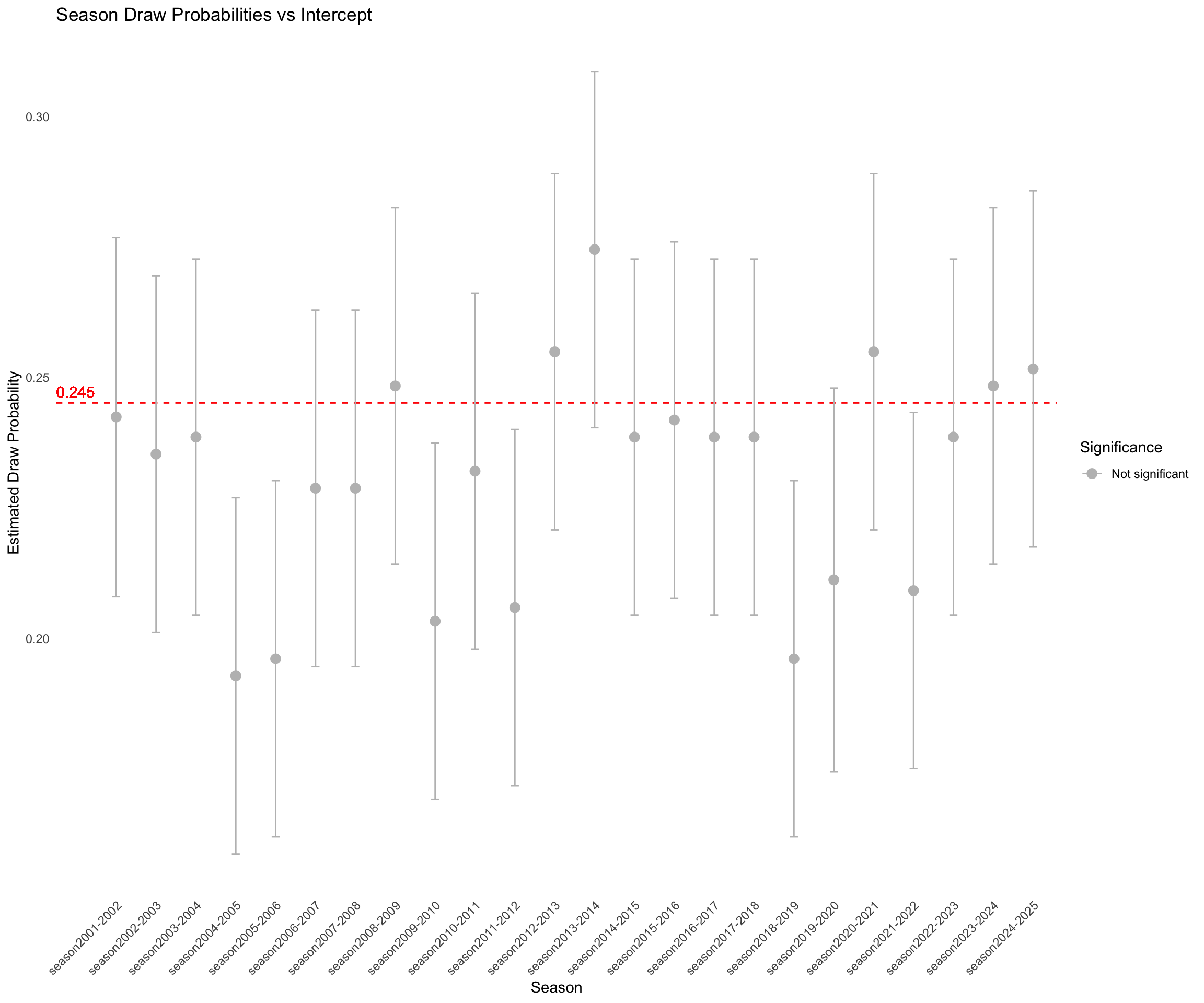
Regressing season on draw or no draw shows:
a significant intercept of 0.245 — 25% chance of any match drawing
no significant effects from any season
an R-squared of 0.002467 with a p-value of 0.77 — basically a useless model to predict
This is not yielding much of a result except for a negative: rounds are not good way to predict for draws in the Eredivisie. I don’t want to be exhaustive about this one so I’m accepting it for what it is.
However, working with rounds has made me think of using them to iterate over in a Bayesian approach. So next analysis: Bayesian!